The Pradhan Mantri Awas Yojana (PMAY) is one of the Government of India’s major housing initiatives, aimed at helping eligible families obtain safe and permanent housing. The scheme has separate components for urban and rural areas, so the eligibility criteria, application process and benefits depend on where the applicant lives.
For urban beneficiaries, PMAY-U 2.0 is the current housing mission. It was launched from September 1, 2024, and is designed to support 1 crore additional eligible urban families over five years through different housing options. The mission supports construction, purchase and affordable rental housing through four verticals: Beneficiary Led Construction (BLC), Affordable Housing in Partnership (AHP), Affordable Rental Housing (ARH) and Interest Subsidy Scheme (ISS). (Press Information Bureau)
For rural households, PMAY-G (Pradhan Mantri Awaas Yojana-Gramin) focuses on eligible rural families who need a pucca house. The official PMAY-G system uses household conditions and socio-economic criteria to assess eligibility. (Pradhan Mantri Awas Yojana Gramin)
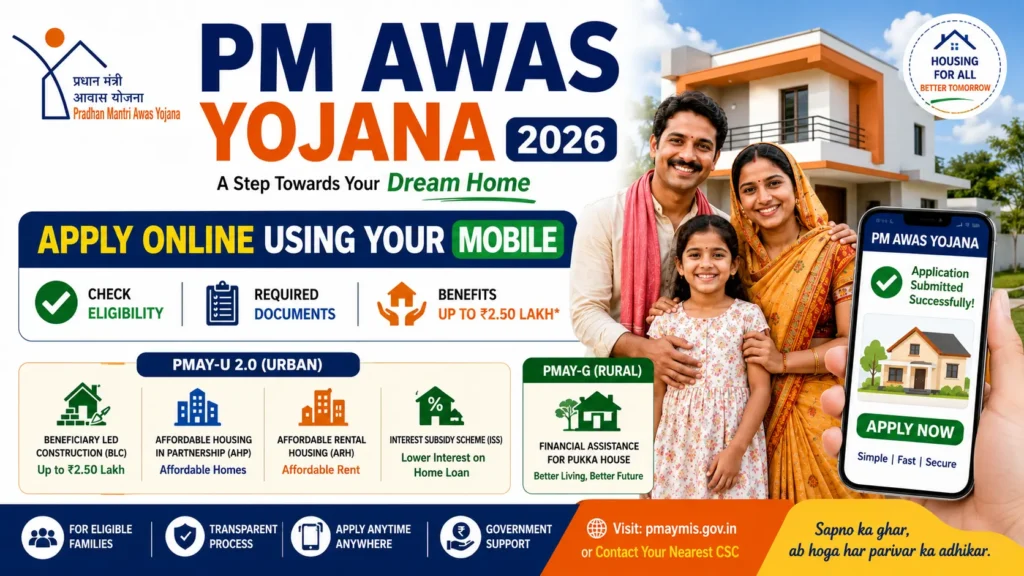
This guide explains PM Awas Yojana 2026, eligibility, documents, benefits and how applicants can use a mobile phone to access the online application or survey process.
What Is PM Awas Yojana?
Pradhan Mantri Awas Yojana is a government housing programme designed to improve access to pucca housing for eligible families.
The programme is divided mainly into:
- PMAY-U / PMAY-U 2.0 for eligible urban households
- PMAY-G for eligible rural households
The urban and rural components should not be confused because they have different eligibility rules and application systems.
PMAY-U 2.0 aims to provide central assistance to eligible urban families through States, Union Territories and participating agencies. The scheme covers eligible EWS, LIG and MIG families who meet the prescribed conditions. (PMAY-HFA)
PM Awas Yojana 2026 – Overview
| Particular | Details |
|---|---|
| Scheme Name | Pradhan Mantri Awas Yojana |
| Urban Component | PMAY-U 2.0 |
| Rural Component | PMAY-G |
| Main Objective | Support eligible families with housing |
| Urban Mission Period | 2024–2029 |
| Urban Target | 1 crore additional eligible beneficiaries |
| Urban Assistance | Up to ₹2.50 lakh under applicable PMAY-U 2.0 assistance |
| Application Mode | Online/Assisted/Local Authority, depending on component |
| Mobile Application | Available for relevant online services and surveys |
| Main Documents | Aadhaar, bank details and other applicable documents |
| Beneficiaries | Eligible urban and rural households |
The exact amount and form of assistance depend on the component and the applicant’s eligibility. (PMAY-HFA)
PMAY-U 2.0 Eligibility 2026
PMAY-U 2.0 is intended for eligible families living in urban areas who fall under the applicable EWS, LIG or MIG income categories and do not own a pucca house anywhere in India.
The official PMAY-U 2.0 eligibility information states that the beneficiary family should not have a pucca house in the name of the applicant or any family member anywhere in the country. (PMAY-HFA)
The income categories for the Interest Subsidy Scheme are:
- EWS: Annual household income up to ₹3 lakh
- LIG: Annual household income above ₹3 lakh and up to ₹6 lakh
- MIG: Annual household income above ₹6 lakh and up to ₹9 lakh
These income limits apply to the relevant PMAY-U 2.0 Interest Subsidy Scheme and should not automatically be applied to every vertical. (PMAY-HFA)
Applicants should also note that people who have already received benefits from a Central Government, State Government or Local Self Government housing scheme during the previous 20 years are generally not eligible for PMAY-U 2.0 under the stated rules. (PMAY-HFA)
PMAY-G Eligibility 2026
For rural households, PMAY-G eligibility is assessed differently.
The official PMAY-G eligibility questionnaire considers factors such as whether the household lives in a rural area, whether it owns a pucca house, the type and size of the existing house, ownership of certain vehicles or agricultural equipment, government employment, income and landholding. (Pradhan Mantri Awas Yojana Gramin)
The PMAY-G system also asks whether the household is houseless or living in a kutcha house and considers several exclusion criteria.
Therefore, rural applicants should not assume that simply living in a village automatically makes them eligible. Their household must satisfy the applicable PMAY-G criteria.
PMAY-U 2.0 Benefits
PMAY-U 2.0 provides different types of assistance through four major verticals.
1. Beneficiary Led Construction
Under the BLC component, eligible EWS families with their own available land can receive financial assistance to construct a new pucca house.
The official PMAY-U 2.0 portal states that BLC assistance can be up to ₹2.5 lakh, with the supported house having a carpet area of up to 45 square metres. (PMAY-HFA)
2. Affordable Housing in Partnership
The AHP component supports affordable pucca housing developed by public or private agencies for eligible beneficiaries.
Eligible EWS beneficiaries can use this component to obtain an affordable house according to the applicable rules. (PMAY-HFA)
3. Affordable Rental Housing
The ARH component focuses on affordable rental housing for eligible groups such as urban migrants, homeless people, industrial workers, working women, construction workers and other eligible EWS/LIG groups. (PMAY-HFA)
4. Interest Subsidy Scheme
Under the ISS component, eligible EWS, LIG and MIG beneficiaries can receive an interest subsidy on qualifying home loans sanctioned and disbursed on or after September 1, 2024.
The applicable annual income limits are up to ₹3 lakh for EWS, ₹6 lakh for LIG and ₹9 lakh for MIG. (PMAY-HFA)
PMAY-G Benefits
PMAY-G provides housing assistance to eligible rural households for construction of a pucca house.
The official PMAY-G guidance describes support for a basic house with a minimum area of 25 square metres, including a hygienic cooking space. It also provides for convergence with other government programmes where applicable. (Pradhan Mantri Awas Yojana Gramin)
The exact assistance and additional benefits should be checked according to the current PMAY-G guidelines applicable to the beneficiary.
Documents Required for PM Awas Yojana
The documents can vary depending on whether the applicant is applying under the urban or rural component.
For PMAY-U 2.0, the official FAQ specifically lists documents such as:
- Aadhaar Card
- Bank account details
- Undertaking confirming eligibility
- Land ownership documents for BLC applicants
- Other documents specified by the State/UT/ULB/PLI
(PMAY-HFA)
Applicants may also need income-related or other supporting documents depending on the selected vertical.
For rural applicants, the documents and verification requirements can depend on the PMAY-G survey and beneficiary identification process.
How to Apply for PM Awas Yojana Using Your Mobile?
The online process depends on whether you are applying under PMAY-U 2.0 or participating in a PMAY-G survey.
Step 1: Identify Your Area
First determine whether your household falls under an urban or rural jurisdiction.
Urban households should check PMAY-U 2.0, while rural households should check the PMAY-G process.
Step 2: Open the Official Portal
Use the official government portal related to the applicable PMAY component.
For PMAY-U 2.0, the official unified web portal provides an online application facility. Applicants can also seek assistance from Common Service Centres or their concerned Urban Local Body/Municipality. (PMAY-HFA)
Step 3: Check Eligibility
Before completing the application, carefully check the eligibility conditions.
For PMAY-U 2.0, important conditions include income category, urban residence and absence of a pucca house anywhere in India. (PMAY-HFA)
Step 4: Select the Applicable Option
Eligible urban applicants may need to select the appropriate PMAY-U 2.0 vertical based on their circumstances.
The four options are BLC, AHP, ARH and ISS.
Once an applicant selects a vertical, the official portal warns that it cannot be changed later, so applicants should read the instructions carefully before proceeding. (PMAY-HFA)
Step 5: Enter Personal Details
Fill in the requested information carefully.
This may include:
- Applicant’s name
- Family details
- Address
- Mobile number
- Aadhaar-related details
- Income information
- Bank details
- Housing information
Make sure the details match your documents.
Step 6: Upload or Submit Documents
Upload the required documents if the online system asks for them.
For BLC applications, land ownership documents are particularly important because the applicant must have available land for construction. (PMAY-HFA)
Step 7: Complete Verification
The application does not automatically guarantee a housing benefit.
The official PMAY-U 2.0 portal clearly states that submitting an application does not mean that the applicant will automatically receive the benefit; eligibility must be verified by the relevant authorities. (PMAY-HFA)
Step 8: Save the Application Details
After submission, save the acknowledgement, application number or other reference details provided by the portal.
These details may be needed later to track the application.
PMAY-G Mobile Survey
For rural households, the AwaasPlus2024 system provides mobile-based survey functionality.
The official PMAY-G website provides information about the AwaasPlus2024 mobile application and self-survey/assisted-survey process. (Pradhan Mantri Awas Yojana Gramin)
This means eligible rural households may be able to participate in the applicable survey process through the authorised mobile application or with assistance from authorised personnel, depending on the current process.
Applicants should download apps only from official government sources and avoid APK files shared through unknown websites or social media.
State-Wise PM Awas Yojana
PMAY is implemented across India through the relevant Central and State/UT authorities. However, local implementation, verification and application support can vary.
| State/UT | Relevant Housing Component |
|---|---|
| Maharashtra | PMAY-U / PMAY-G as applicable |
| West Bengal | PMAY-U / PMAY-G as applicable |
| Gujarat | PMAY-U / PMAY-G as applicable |
| Rajasthan | PMAY-U / PMAY-G as applicable |
| Uttar Pradesh | PMAY-U / PMAY-G as applicable |
| Bihar | PMAY-U / PMAY-G as applicable |
| Karnataka | PMAY-U / PMAY-G as applicable |
| Tamil Nadu | PMAY-U / PMAY-G as applicable |
| Madhya Pradesh | PMAY-U / PMAY-G as applicable |
| Odisha | PMAY-U / PMAY-G as applicable |
| Jharkhand | PMAY-U / PMAY-G as applicable |
| Assam | PMAY-U / PMAY-G as applicable |
| Other States/UTs | Check the applicable official PMAY authority |
The urban component is implemented through participating States/UTs and local authorities, while rural housing is administered through the rural development system. (PMAY-HFA)
Who Gets Preference Under PMAY-U 2.0?
PMAY-U 2.0 gives special focus to several groups.
These include:
- Widows
- Single women
- Persons with disabilities
- Senior citizens
- Transgender persons
- Scheduled Castes and Scheduled Tribes
- Minorities
- Safai Karmis
- Street vendors identified under PM SVANidhi
- Artisans covered under PM Vishwakarma
- Anganwadi workers
- Building and construction workers
- Slum and chawl residents
- Other weaker and vulnerable groups
(PMAY-HFA)
Preference or focus does not mean automatic approval. Applicants must still meet the relevant eligibility requirements.
Important Things to Remember Before Applying
Before submitting a PM Awas Yojana application, keep the following points in mind:
Check the correct scheme: Urban and rural housing programmes have different processes.
Use official websites: Avoid unofficial websites claiming guaranteed PMAY approval.
Keep documents ready: Aadhaar, bank details and other applicable documents should be accurate.
Do not submit false information: Incorrect information can affect verification and eligibility.
Save your application number: Keep the acknowledgement safely for future reference.
Do not pay unofficial fees: Be careful if someone asks for money in exchange for guaranteed approval.
Check the selected vertical carefully: Under PMAY-U 2.0, the selected vertical cannot be changed later according to the official portal. (PMAY-HFA)
Frequently Asked Questions (FAQ)
1. What is PM Awas Yojana 2026?
PM Awas Yojana is a Government of India housing programme with separate urban and rural components designed to support eligible households in obtaining pucca or affordable housing.
2. Can I apply for PM Awas Yojana using my mobile phone?
Yes. PMAY-U 2.0 provides an online application facility, while PMAY-G has mobile-based survey facilities such as AwaasPlus2024 for applicable rural processes. (PMAY-HFA)
3. Who is eligible for PMAY-U 2.0?
Eligible urban families belonging to EWS, LIG or MIG categories may qualify if they meet the scheme conditions, including not owning a pucca house anywhere in India. (PMAY-HFA)
4. How much assistance is available under PMAY-U 2.0?
Government assistance can be up to ₹2.5 lakh per unit under the applicable PMAY-U 2.0 framework, but the actual benefit depends on the selected vertical and eligibility. (PMAY-HFA)
5. What documents are required?
Common documents include Aadhaar, bank account details, an eligibility undertaking and, for BLC applications, land ownership documents. Additional documents may be required by the relevant authority. (PMAY-HFA)
6. Can someone who already owns a pucca house apply?
For PMAY-U 2.0, a family owning a pucca house in the name of the applicant or any family member anywhere in India is not eligible under the stated criteria. (PMAY-HFA)
7. Is PMAY-U 2.0 available in rural areas?
No. PMAY-U 2.0 is the urban housing component. Eligible rural households should check PMAY-G and the applicable rural housing process. (PMAY-HFA)
8. Can I apply for both PMAY-G and PMAY-U 2.0?
The applicable component depends on your jurisdiction. The official PMAY-U 2.0 FAQ states that beneficiaries may avail benefits under either PMAY-G or PMAY-U 2.0 depending on their jurisdiction. (PMAY-HFA)
9. Does filling out the online form guarantee a house?
No. Submitting an application does not automatically guarantee the benefit. The relevant authorities must verify eligibility and approve the application. (PMAY-HFA)
10. Can I apply through a Common Service Centre?
Yes. PMAY-U 2.0 allows eligible beneficiaries to submit applications through Common Service Centres, as well as through the unified online portal or the concerned Urban Local Body/Municipality. (PMAY-HFA)
Conclusion
PM Awas Yojana 2026 continues to be an important government housing initiative for eligible families across India. However, applicants should first identify whether they come under the urban PMAY-U 2.0 or rural PMAY-G component.
For urban applicants, PMAY-U 2.0 provides multiple options including construction, affordable housing, rental housing and interest subsidy. Eligible EWS families with their own land may receive assistance of up to ₹2.5 lakh under the BLC component, while eligible home-loan borrowers may benefit through the Interest Subsidy Scheme. (PMAY-HFA)
For rural applicants, PMAY-G uses household and socio-economic criteria to identify eligible families, with mobile-based survey facilities available through the AwaasPlus system for applicable processes. (Pradhan Mantri Awas Yojana Gramin)
If you plan to apply using your mobile phone, use only official government portals or authorised service centres, keep your documents ready and carefully verify all information before submitting the application. Most importantly, remember that online application does not guarantee approval; the final benefit depends on official eligibility verification and sanction.
Declaration
The information provided on this website is for general informational purposes only. We try to keep our content accurate and updated, but we do not guarantee its completeness or reliability. Users should verify important details through the official government websites before applying for any job, scheme, examination, or benefit. This website is independently operated and is not affiliated with any government organization. We are not responsible for any loss, error, delay, or misunderstanding arising from the use of this information.